
Art as Medicine: The Work of J. Faye D'Avanza

How one West Asheville coach is helping creatives find their way back to themselves — and why the stakes are higher than you think.
By Travis Richardson | Last Updated: May 2026 | Asheville, NC
Photos by: Elin Oom Photography / @elinophotos
A note from Travis: Asheville is defined by its artists. Walk any block in the River Arts District, duck into a gallery on Lexington Avenue, or sit in on a workshop at Story Parlor — you'll find people who have chosen to make creativity the center of their lives, often at real personal cost. That commitment matters. It shapes the culture, the energy, and the healing capacity of this city in ways that don't show up on a wellness chart but are felt by everyone who lives here. When I started Be Well Asheville, I made a deliberate choice to cover not just massage therapists and yoga studios, but the artists and creative practitioners who are, in many ways, doing the deepest wellness work of all. Faye D'Avanza is one of those people. Her story — from burned-out librarian to creative empowerment coach — is the kind of journey that reminds you why Asheville draws people in the first place. I wanted to feature her because she puts into words something this city has always known: that making art isn't a hobby. It's how we stay whole.
I loved my recent interview with J. Faye D’Avanza — her energy and smile were totally contagious.
Through her own experiences, she’s found a way to help writers, artists, and folks who’ve kinda forgotten who they are slow down, create, and gently find their way back to themselves.
Faye is a writer, creative care practitioner, and the founder of Library of Care — a practice built on the belief that art and wellness in Asheville share the same root system. She is an Inward & Artward certified creative facilitator, a certified book editor, and a yoga teacher (RYT-200). Creativity, in her framework, is not a reward for finishing your real work. It is the real work.
The Thesis Hidden Inside a Burnout
Faye's path to this work is the kind that only makes sense in retrospect. She spent two decades as a public librarian — a career she genuinely loved, rooted in service, curiosity, and community. Beginning as a book shelver during Y2K, then a Reference Librarian through the Great Recession, and eventually a Community Engagement Librarian who built a vibrant public programming department, she gave herself fully to the work. But when COVID shuttered the library she had spent years building, something inside her broke loose.
"I had been giving so much of myself to others and not to myself," she says. "And I knew that whatever I built next was going to be for me."
-Faye
She left her position in November 2021, at the height of the Great Resignation — one of 4.5 million Americans who quit their jobs that month. She didn't have a plan. What she had was bone-deep exhaustion and a book she desperately wanted to write.
Burnout, however, had taken more than her energy. It had taken her creativity. "I felt like I had become so disconnected from that vital creative life force," she says, "that I needed to find like this breadcrumb trail back to the main trail."
That breadcrumb trail eventually led her here — to Asheville, to West Asheville Yoga, to Story Parlor, and ultimately to a new understanding of what it actually means to be well.
Creativity Is Not a Luxury. The Research Agrees.
What Faye arrived at through lived experience, science has been quietly confirming for decades.
The data is not subtle. Research consistently shows that when people make art, they get better — across populations, conditions, and life stages:
- 81% improvement in overall psychological health — A study in The Arts in Psychotherapy found that the vast majority of patients reported measurable improvement in mental and emotional well-being after art therapy sessions.
- 71% reduction in anxiety among cancer patients — Research published in the Journal of the National Cancer Institute found that creative arts therapies provided significant emotional support and stress relief for people navigating serious illness.
- 76% of veterans reported post-traumatic growth — A study in Art Therapy: Journal of the American Art Therapy Association found that art therapy fostered resilience and emotional healing in those who had experienced trauma.
- 79% of children showed increased self-esteem — Research in Arts & Health found that art therapy positively impacted self-image and personal growth in younger participants — effects that carry forward into adulthood.
- 68% of trauma survivors saw reduced PTSD symptoms — According to a study in the Journal of Traumatic Stress, creative interventions meaningfully supported recovery and emotional wellbeing after traumatic events.
- 77% of participants with autism showed improved communication — Research in the Journal of Autism and Developmental Disorders revealed that art therapy enhanced social connection and communication skills across diverse needs.
Furthermore, research on older adults consistently links arts participation to reduced rates of cognitive decline, improved mood, and greater resilience in the face of adversity. The data is not subtle: when people make art, they get better.
Asheville is fortunate to have practitioners who have built entire practices around this premise. Higgins Wellness offers expressive arts therapy that blends visual arts, movement, music, drama, and writing — with sessions designed around releasing and discovering rather than producing "good" art. Western NC Art Therapy, led by certified art therapists, offers workshops like their Zentangle drawing series to cultivate relaxation and meditative focus. And Still Point Wellness runs a 12-week immersive journey based on The Artist's Way by Julia Cameron — the same book that helped shape Faye's own path back to creativity. Creative expression, in all of these spaces, isn't decoration. It's the whole point.
Faye encountered this idea most directly in Beth Pickens' book Make Your Art No Matter What. "She says that as artists, we have to make our art, otherwise our wellbeing suffers," Faye recalls. "When I read that, I knew — that's the connection point."
It was a truth she had already lived. For years, she had fed everyone else's creativity while her own quietly starved. And when it did, the rest of her suffered with it.
From Shushed to Speaking
There is a particular kind of silencing that happens in service professions. Faye knows it intimately.
"I felt like I had shushed myself," she says, "living and working in a very people-pleasing culture." The irony of a librarian — a profession culturally associated with quieting others — turning that same silence inward wasn't lost on her. What it took to find her voice again was a combination of writing practice, somatic movement, and what she calls a return to the body.

"Yoga and writing were like a pathway for me to move out blocks that I had inside of me," she explains. "A way for me to become more embodied and also use my voice."
As a writer, she had become, in her own words, "a walking head with no body." Burnout and anxiety had severed her from her physical self. Consequently, getting back to wholeness meant getting back into the body first — through yoga, then through intentional creative practice, and eventually through a synthesis of both.
That synthesis became the foundation of everything she now offers. Today, Faye helps highly creative people navigate the terrain between depletion and renewal, weaving together breath work, movement, and creative inquiry into a human-first approach to wellbeing.
The daughter of a renowned clockmaker — a man who repairs tower clocks across New England — Faye brings to her work a deep understanding of what it means when something stops ticking. "There's that part inside of us that needs tending, it needs care," she says. "It needs that every 24 hours. It's really about moving that stress out of our body — and that's a big part of where the wellness piece comes in for creativity."
Asheville as Container
It's worth noting that Faye chose Asheville — and that Asheville, in its way, chose her back.
"The different communities I've found in Asheville really helped bring me back to life," she says. "I just love that intersection where the creative community and the wellness community come together."
That intersection may be nowhere more visible than in the River Arts District — the stretch of former industrial spaces along the French Broad River that has become one of the most concentrated creative ecosystems in the American South. In February 2026, USA Today readers voted the RAD the #1 arts district in the country — a recognition that surprised no one who has walked its studios, attended its openings, or watched artists return to it after unspeakable loss.
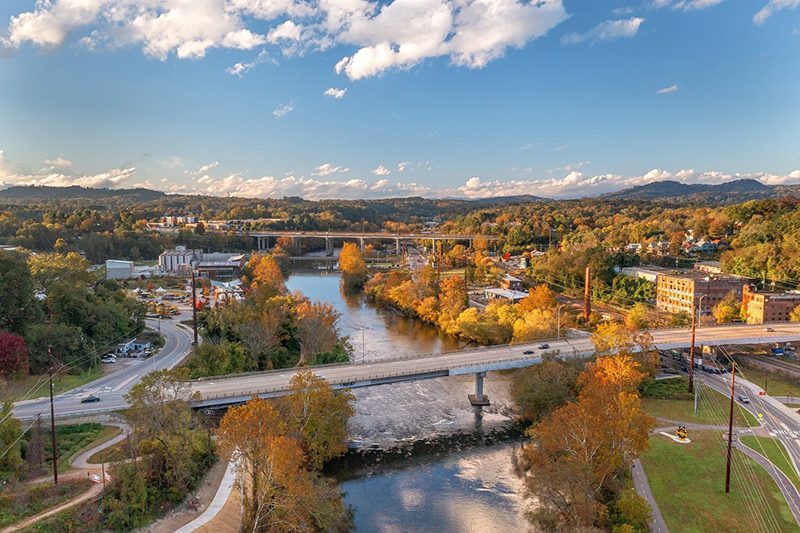
Because the RAD has had to earn that title twice now.
When Hurricane Helene struck in September 2024, floodwaters devastated up to 80% of the district. More than 300 artist studios were damaged or destroyed. Over 750 working artists were affected. And yet, by spring 2025, more than 500 had returned. The Marquee, a landmark gathering place for over 320 artists and vendors, reopened in fall 2025 after a full year of restoration. New spaces continued to emerge up and down the corridor.
The River Arts District didn't simply rebuild. It reimagined itself.
That kind of resilience doesn't happen in a vacuum. It happens in communities that understand — at their deepest root — that art is not ornamental. A culture where art flourishes is a culture that is, in some essential way, healthy. When artists are priced out, displaced, or swallowed whole by survival mode, it tells a different and darker story. The community's obligation to support its artists isn't sentiment. It's self-preservation.
Faye was here for both seasons of that story.
After the Storm: Returning to the Body
Immediately following Helene, Faye was brought in through Mountain BizWorks and Craft Your Commerce to lead creative healing sessions for the community — artists, arts nonprofit leaders, and creative-based business owners directly impacted by the storm.
"It was really about moving that stress out of our body," she says. "It's really hard to be creative when you're stressed out, living in fight-or-flight survival mode all the time. After the hurricane, I was helping ground people — bringing them back to their bodies, back to community, with reminders that we are safe."
"It was really about moving that stress out of our body. It's really hard to be creative when you're stressed out."
-Faye
The sessions weren't art classes in any traditional sense. They were, more fundamentally, reminders of what it means to be human — to breathe, to feel, to make something, together.
"Once we can switch our brain and body over into a more creative space," she explains, "we have the capacity to come up with solutions and show up in the ways we actually want to."
There is science behind this. Burnout: The Secret to Unlocking the Stress Cycle by Amelia and Emily Nagoski — a book foundational to Faye's coaching work — articulates the physiology: every 24 hours, the body needs to complete a full stress cycle. Without that, stress accumulates. Eventually, we deplete. Movement, creativity, and community are not the opposite of productivity. They are, as it turns out, its prerequisite.
A Monthly Reset — and a Free Guide to Get You Started
Each first Sunday, something quiet and necessary happens at Story Parlor in West Asheville.
Faye calls it Creatives Over Easy: A Monthly Soul Reset. It runs from 10am to noon. It costs ten dollars. And it is, in her own words, "my version of a creativity support group" — an intentional drop-in circle for people who want to reflect, share, and genuinely engage with what it means to live a whole creative life.
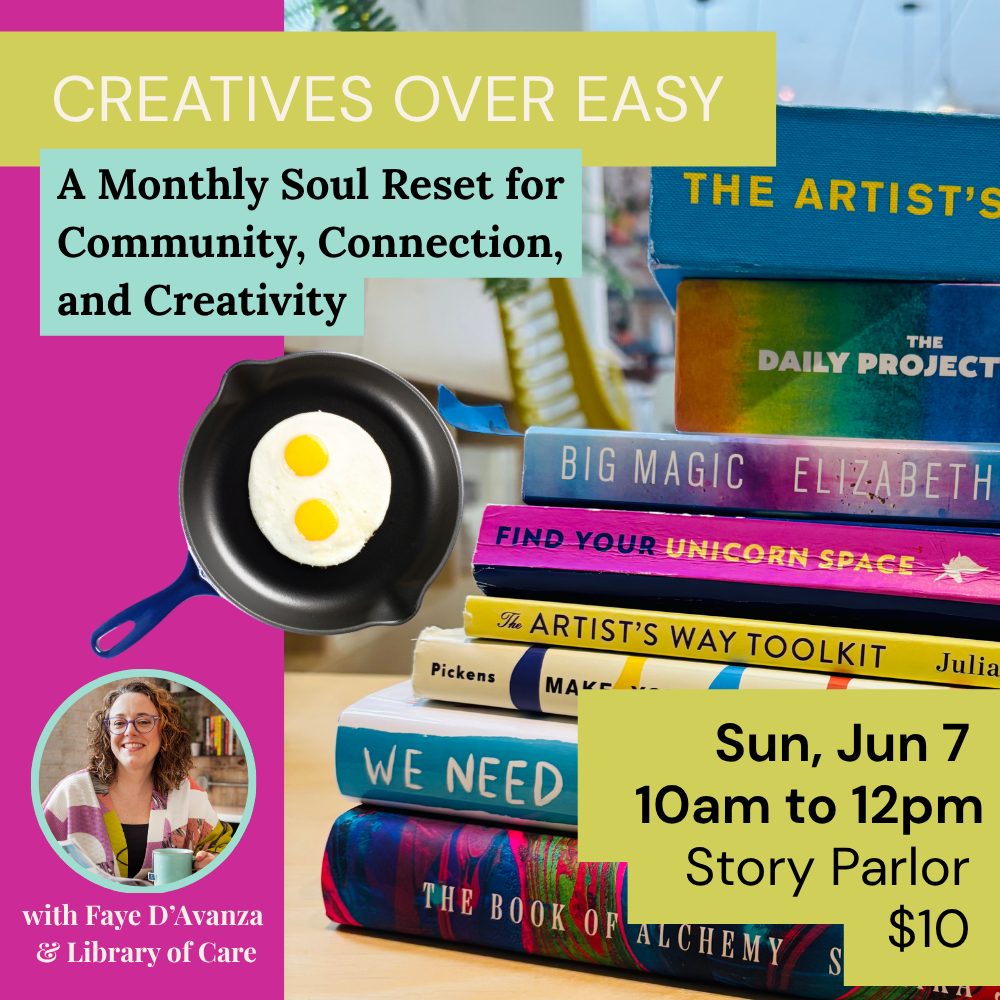
"We try to tap into the inner child," she says. "That's where so much of this work lives — how do we get back to the person we used to be? It's about finding that breadcrumb trail again."
The next gathering is Sunday, June 7 at Story Parlor, 227 Haywood Road, West Asheville. Tickets are $10 and can be reserved at storyparloravl.com.
Additionally, beginning in June, Faye is opening her books for one-on-one creative empowerment coaching. For those ready for a deeper immersion, she'll also be offering a Whole Creative Living Weekend — two days of creative exploration, embodied practice, and community, split between Story Parlor and an artist space in the city.
Want to begin right now? Subscribe to Faye's indie newsletter, Keeping Creative Time, on Substack — a weekly-ish journey through what it means to live a more joyful and easeful whole-creative life. Every subscriber receives a free invite to download this season's Nourish Your Creative Joy experience guide — a bingo-style creative activity guide inspired by Burnout and The Artist's Way that helps your creative energy emerge through simple, meaningful practices. Complete your guide by June 20, and you'll be entered to win this season's giveaway: The Practice of Attention by Cody Cook-Parrott.
To learn more, book a free creative questions chat, or explore all of Faye's offerings, visit jfayedavanza.com or follow her on Instagram at @jfayedavanza and @libraryofcare.
Keep Exploring Asheville's Creative Scene
Asheville's arts ecosystem runs deep. If this conversation sparked something in you, here are a few places to keep going:
- River Arts District — The heartbeat of Asheville's working artist community. Visit studios, find events, and support the artists who make this city what it is.
- Explore Asheville: Arts & Culture — A comprehensive guide to galleries, museums, public art, and cultural experiences across the region.
- Asheville Art Museum: Learn — Classes, workshops, and educational programming for all ages and skill levels.
- Art Classes in Asheville — A curated roundup of hands-on creative experiences throughout the city.
- Zen Mountain Gallery & Studio: The Work of Rod MacIver — Another RAD artist whose work lives at the intersection of art, nature, and meaning. A neighbor worth knowing.
